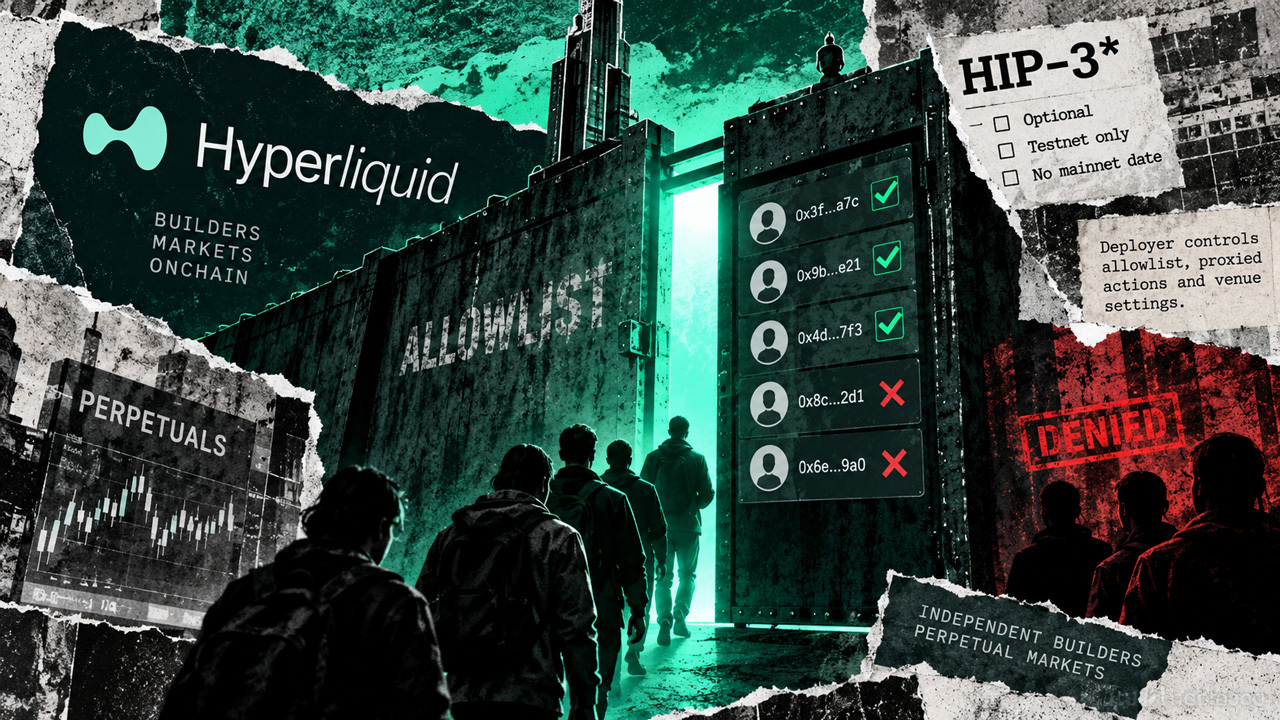
Hyperliquid is testing a new protocol improvement, HIP-3, which introduces venue-scoped controls that allow market operators to implement allowlists for their specific markets. This update enables operators to define exactly who can participate in their trading venues, effectively creating gated liquidity environments. Crucially, these controls are localized to the specific venue, meaning they do not change the underlying mechanics or accessibility of Hyperliquid’s existing permissionless markets, which remain open to all users.
The introduction of allowlists marks a significant shift toward institutional readiness for the decentralized exchange. By allowing operators to restrict access, Hyperliquid provides a pathway for entities that require strict KYC (Know Your Customer) and AML (Anti-Money Laundering) compliance to operate within a decentralized infrastructure. This hybrid approach allows the platform to cater to both the traditional DeFi community and regulated financial institutions that were previously hesitant to participate in fully permissionless environments.
From a regulatory perspective, this move aligns with the 2026 trend of 'compliant DeFi,' where protocols integrate tools to satisfy US and international oversight while maintaining a decentralized backend. For US-based traders, this could mean the arrival of more institutional-backed liquidity pools on Hyperliquid, potentially narrowing spreads and increasing depth for high-volume pairs. However, the protocol maintains a delicate balance to ensure that the primary permissionless experience remains unencumbered by these opt-in restrictions.
Market observers should watch for which major market makers or institutional venues are the first to deploy these allowlisted markets. The success of HIP-3 will likely be measured by the growth in institutional volume and whether other decentralized perpetual exchanges follow suit with similar permissioning tools. As the 2026 trading year progresses, the focus will be on whether these gated venues cannibalize existing liquidity or successfully bring new, sidelined capital into the Hyperliquid ecosystem.