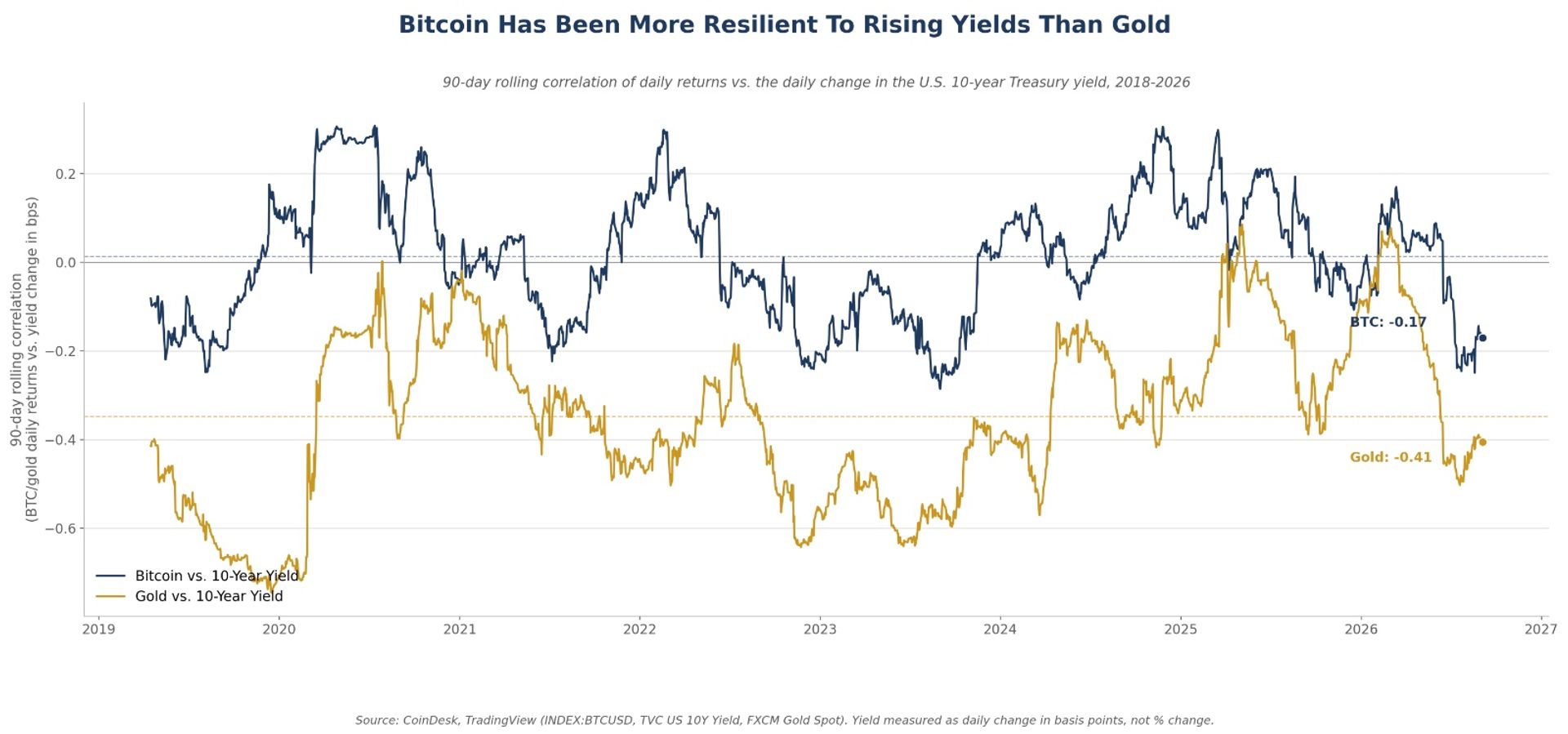
Bitcoin has demonstrated remarkable resilience against Treasury yield volatility in early September 2026, outperforming gold in terms of price stability during recent yield spikes. While rising yields typically exert downward pressure on non-yielding assets, Bitcoin’s price movements have remained significantly less reactive than gold’s, indicating a decoupling from traditional 'safe-haven' correlation patterns. This shift suggests that the crypto market's liquidity profile is evolving to handle macroeconomic shocks more effectively than the bullion market.
The data from the September 7 market session highlights a trend where a sudden jump in 10-year Treasury notes triggered a sharper sell-off in gold than in the cryptocurrency sector. This divergence occurs amidst a complex 2026 macroeconomic environment where US fiscal policy continues to drive bond market uncertainty. Unlike gold, which is heavily influenced by real interest rate movements, Bitcoin is being buoyed by a combination of digital scarcity and a broader global adoption curve that appears less sensitive to the specific movements of the US yield curve.
For the crypto market, this increased stability signifies maturing institutional adoption and a broader acceptance of Bitcoin as a core portfolio diversifier rather than a purely speculative asset. If Bitcoin continues to 'blink less' than gold in the face of bond market volatility, it could lead to significant capital reallocation from traditional precious metals into digital assets. Institutional desks are now closely monitoring whether this decoupling represents a permanent change in how 'risk-off' sentiment is expressed in the 2020s.
Moving forward, investors should watch for the upcoming Treasury auctions and Federal Reserve commentary later this month to see if Bitcoin’s resilience holds during sustained yield climbs. A continued lack of correlation with gold during yield volatility would solidify Bitcoin’s status as 'digital gold' with superior market dynamics. Furthermore, any specific US regulatory updates regarding stablecoin reserves could further impact how treasury-linked volatility flows through the broader crypto ecosystem.