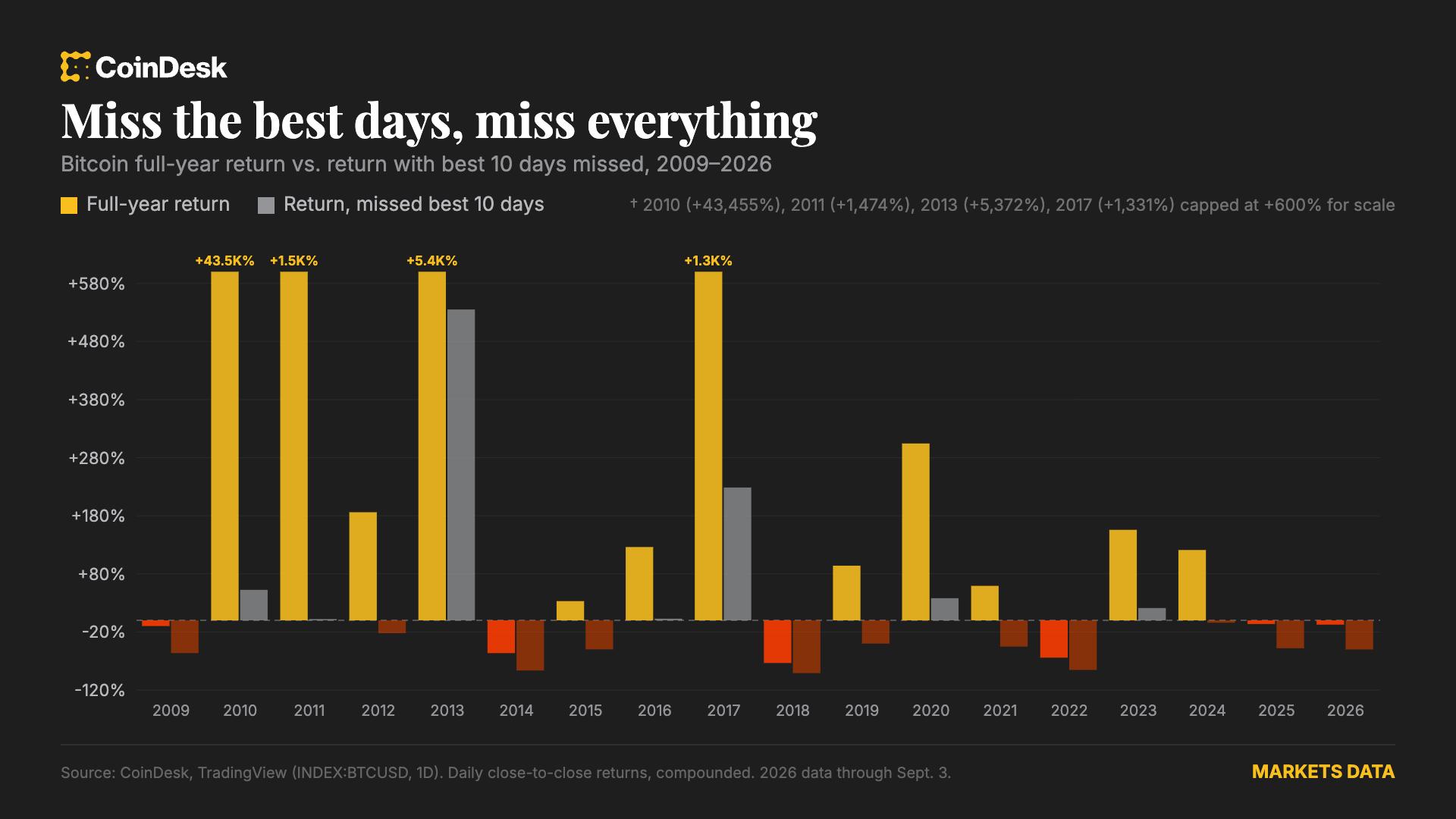
A long-term buy-and-hold strategy, often referred to as 'HODLing,' outperforms market timing because Bitcoin's price appreciation is historically concentrated in a very small number of trading days. Data spanning from 2010 through projected trends in 2026 indicates that the vast majority of the asset's annual returns happen during a narrow window. For investors, this means that being out of the market for even a few days can result in missing the bulk of the year’s profits, often transforming a potentially lucrative year into a flat or negative one.
This phenomenon occurs because Bitcoin often undergoes periods of sideways or downward movement followed by sudden, parabolic price spikes. These explosive moves are frequently triggered by unpredictable macroeconomic shifts, supply-side shocks, or major institutional announcements. Because these 'green days' are nearly impossible to predict with consistency, traders who exit the market to avoid volatility often find themselves chasing the price higher, incurring higher fees and taxes in the process.
For US-based investors, this research reinforces the importance of time in the market rather than timing the market. In a landscape increasingly dominated by institutional players and spot ETFs, the liquidity profile of Bitcoin is shifting, but the tendency for rapid price discovery remains a core characteristic. This data serves as a cautionary tale against the risks of frequent trading, which can lead to significant opportunity costs if an investor is sidelined during a breakout.
Moving forward, market participants should watch how the maturation of the crypto market and the introduction of regulated financial products influence these periods of concentrated growth. While the influx of institutional capital via ETFs might lead to slightly more sustained trends, the fundamental volatility of Bitcoin suggests that a passive accumulation strategy remains the most reliable path for capturing the asset’s long-term upside.