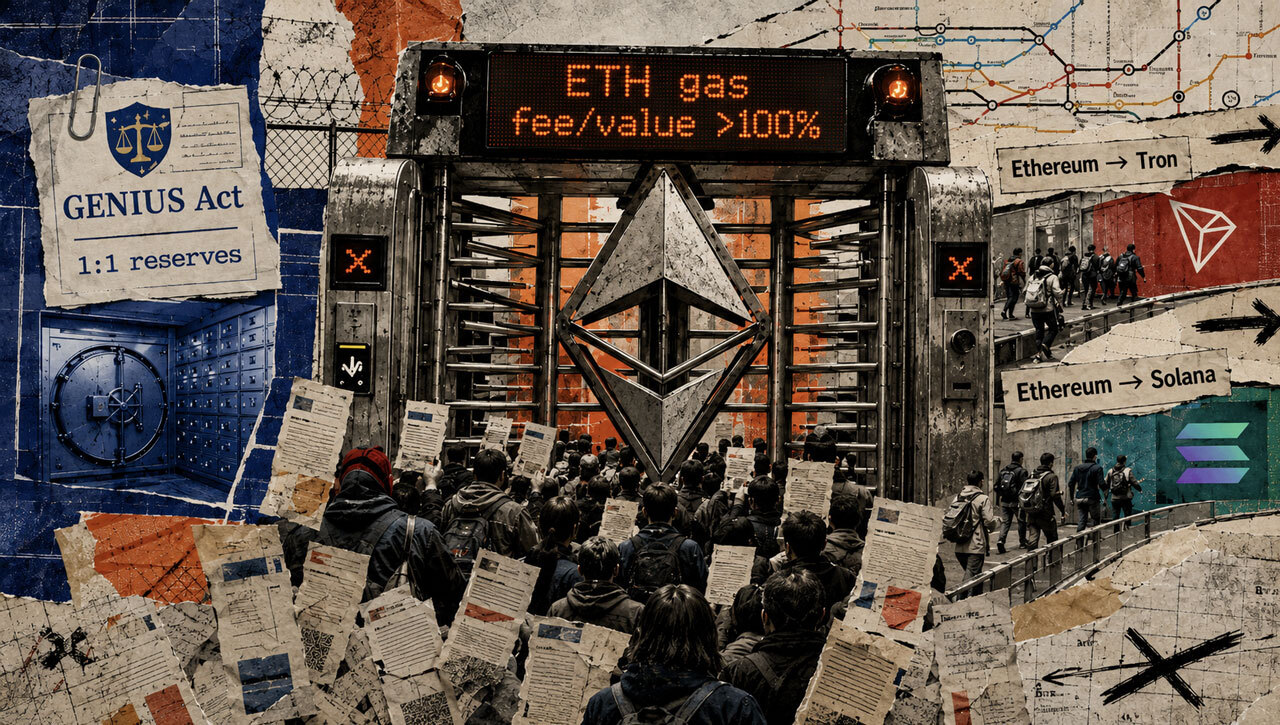
According to a Federal Reserve staff paper titled "GENIUS" (General Equilibrium Network effects in Interchangeable Usable Stablecoins), blockchain congestion triggers bank runs by increasing transaction costs to a point where the stablecoin loses its utility as a medium of exchange. When a network becomes too expensive or slow to use, holders face a "network-driven run" where they rush to redeem their tokens for fiat or migrate to more efficient chains. This phenomenon creates a negative feedback loop: as users leave, the network effect diminishes, further incentivizing others to exit before liquidity dries up or costs rise even higher.
The paper highlights that traditional safeguards, such as one-to-one backing with US Treasuries, may not be enough to prevent a crisis if the underlying infrastructure fails. The research introduces the concept of "chain migration," where a stablecoin's value on a congested network might trade at a discount compared to the same stablecoin on a faster network. This disparity can lead to sudden, mass redemptions that pressure the issuer's liquidity reserves, regardless of the quality of the assets backing the coins.
For US-based investors and crypto platforms, this research underscores that the safety of a digital dollar is tethered to the scalability of its host blockchain. In the eyes of the Federal Reserve, a stablecoin is only as stable as the network it lives on. This adds a new dimension to the ongoing debate over stablecoin regulation, suggesting that lawmakers may eventually require minimum throughput or interoperability standards to protect consumers from network-level failures.
Looking ahead, market participants should watch how major issuers like Circle and Tether diversify across Layer-2 solutions and alternative blockchains to mitigate these congestion risks. Additionally, this Fed research may influence the language of upcoming stablecoin legislation, potentially shifting focus toward technical infrastructure audits in addition to traditional financial reserve audits. As the US moves closer to a regulated digital asset framework, the technical resiliency of networks like Ethereum and Solana will be viewed as a core component of financial stability.