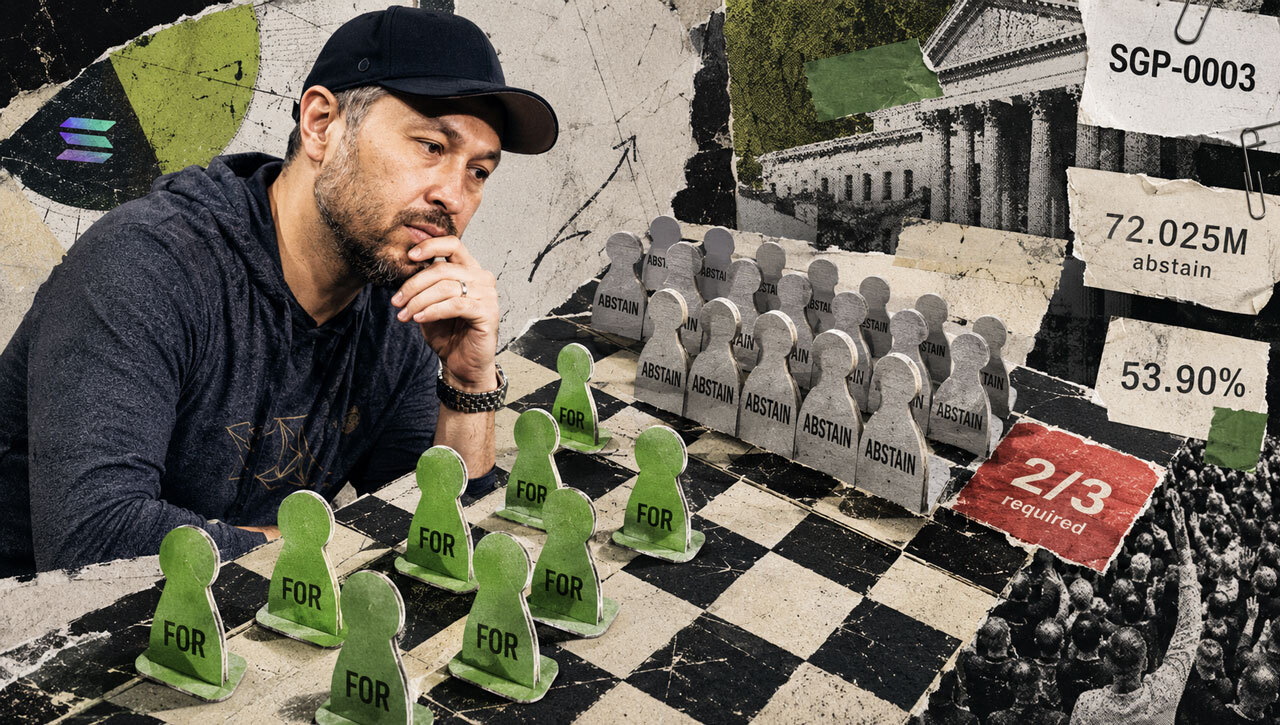
Solana's recent fee reform proposal failed because it could not secure the necessary two-thirds supermajority required for protocol changes, despite receiving majority support from the voting block. While co-founder Anatoly Yakovenko was a vocal advocate for the reform—which aimed to adjust how priority fees are distributed to validators—the ultimate decision-making power rested with the network’s independent validators and stakers. This event serves as a concrete example of Solana’s decentralized governance mechanism in action, overriding the preferences of its most prominent leadership.
The failed vote centered on a proposal to change the economic structure of the network, specifically addressing whether a larger portion of transaction fees should be burned or distributed to validators. While a simple majority of participants favored the change, the supermajority rule acted as a safeguard to ensure that significant economic shifts only occur with broad consensus. For US-based investors and developers, this highlights a layer of 'checks and balances' within the ecosystem that prevents a single entity or founder from unilaterally dictating protocol-level changes.
From a political and regulatory perspective, this outcome provides a counter-narrative to the common criticism that Solana is overly centralized or controlled by its founding team. By demonstrating that validators can and will vote against the founder’s public stance, the network strengthens its case for decentralization—a key factor often scrutinized by the SEC and other regulators when determining the security status of digital assets. However, the failure to implement the reform also means that the underlying economic friction the proposal sought to solve remains unaddressed for now.
Looking ahead, market participants should watch for a revised proposal or a shift in validator sentiment. The tension between protocol efficiency and validator incentives remains a critical hurdle for Solana's long-term scaling strategy. As the network continues to handle high transaction volumes, finding an economic model that satisfies both stakers and the core development team will be essential for maintaining network stability and investor confidence.