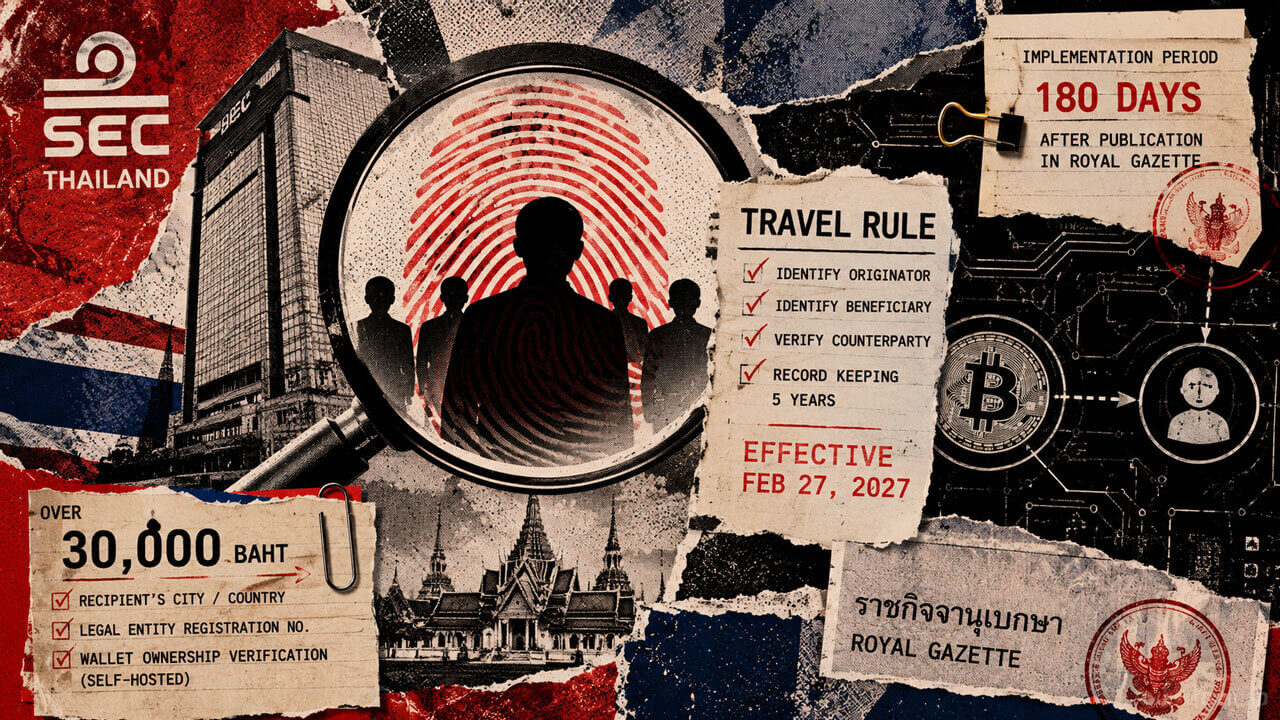
Thailand has tightened its regulatory framework for digital assets by mandating that all licensed crypto operators collect and verify recipient information for every transaction. The most significant change involves a 30,000 baht threshold; any transfer exceeding this amount requires operators to gather additional personal details about the recipient. Furthermore, the new rules place private, self-hosted wallets under intense scrutiny, requiring exchanges to verify the ownership or control of these 'unhosted' addresses before allowing transfers to proceed.
This move is a direct implementation of the 'Travel Rule' promoted by the Financial Action Task Force (FATF), a global money laundering watchdog. By forcing licensed exchanges to track the flow of funds to offshore platforms and private hardware wallets, Thai authorities aim to eliminate the anonymity that has previously characterized cross-border crypto movements. This regulatory pivot signals Thailand's intent to shed its image as a lax jurisdiction for digital assets and instead become a compliant hub within the international financial system.
For US-focused investors and expats, these developments serve as a bellwether for global regulatory trends. The targeting of self-hosted wallets is a particularly contentious issue that has been debated by the US Treasury and FinCEN. Thailand’s aggressive stance could provide a template for other nations looking to bridge the gap between decentralized finance (DeFi) and traditional banking oversight, potentially increasing compliance costs for platforms operating in Southeast Asia.
Market participants should expect increased friction when moving funds between Thai exchanges and external wallets. While these measures may deter illicit activity, they also raise significant privacy concerns for legitimate users who prefer non-custodial storage. In the coming months, observers should watch for how these rules affect the liquidity of Thai exchanges and whether other regional neighbors, like Vietnam or Indonesia, follow suit with similar restrictive measures on private wallet interactions.