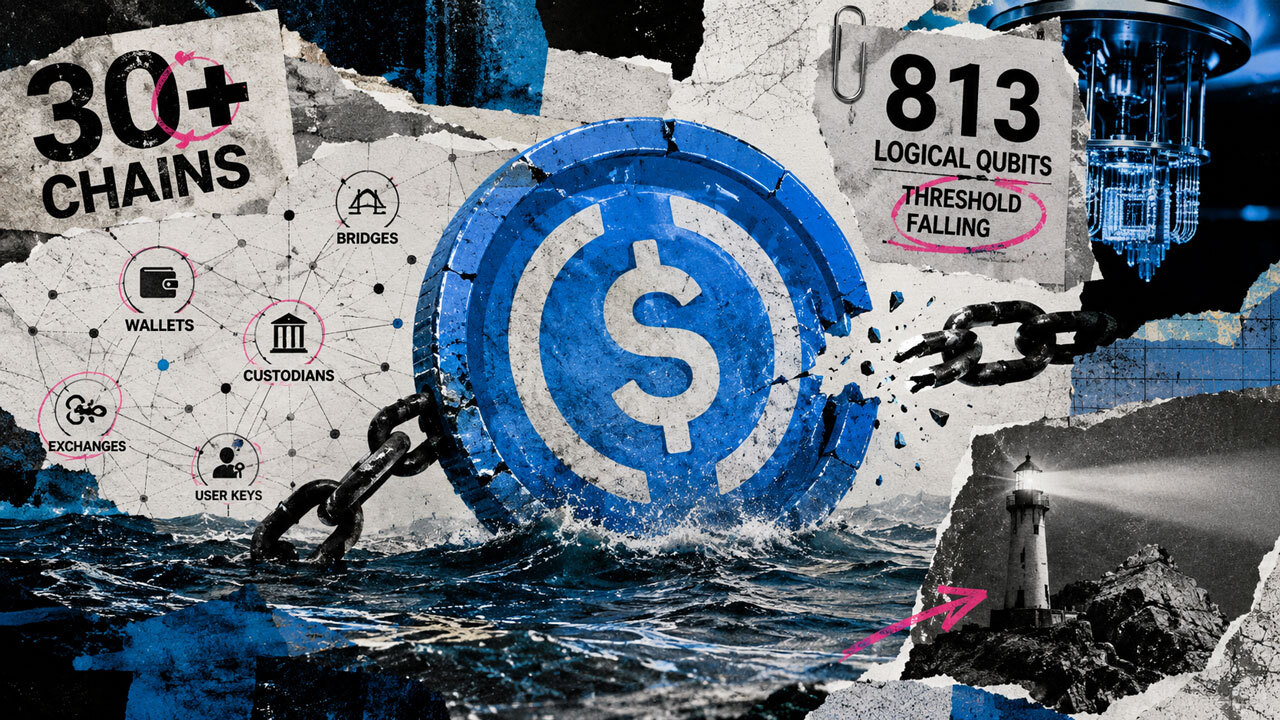
Circle’s USDC is only as quantum-safe as the slowest wallet, bridge, or blockchain in its network because the stablecoin relies on a vast, decentralized infrastructure that Circle does not entirely control. While Circle can upgrade its internal issuance and redemption protocols to withstand quantum attacks, the assets remain at risk if they are stored in wallets using legacy signature schemes or moved across bridges with outdated encryption. The recent achievement of an 813-logical-qubit record signals that the timeline for 'Q-day'—the point when quantum computers can crack current encryption—is accelerating, making systemic upgrades a priority for the entire crypto industry.
For US-based investors and institutional users, this highlights a critical systemic risk: the fragmentation of USDC across multiple chains like Ethereum, Solana, and Base. If a specific bridge or a minor blockchain hosting USDC does not migrate to post-quantum cryptography (PQC), any USDC held or routed through that path becomes a prime target for quantum-enabled theft. This interdependence means that Circle must not only lead its own technological shift but also coordinate a massive migration across its partner network to maintain the stablecoin's integrity.
From a regulatory and market perspective, this challenge may lead to a 'flight to quality' where liquidity moves away from older or slower-to-innovate chains toward those that prioritize PQC standards. US regulators are increasingly focused on the operational resilience of stablecoins, and the ability to withstand quantum threats will likely become a benchmark for compliance. If certain DeFi protocols or bridges lag behind, Circle may eventually be forced to 'sunset' support for those platforms to protect the broader USDC ecosystem.
Investors should watch for upcoming announcements regarding Circle’s adoption of NIST-approved quantum-resistant algorithms and whether they set deadlines for third-party partners to comply. The transition will likely be a multi-year process, requiring users to eventually migrate their holdings to new 'quantum-secure' wallet addresses to ensure their funds remain protected against the evolving capabilities of quantum hardware.