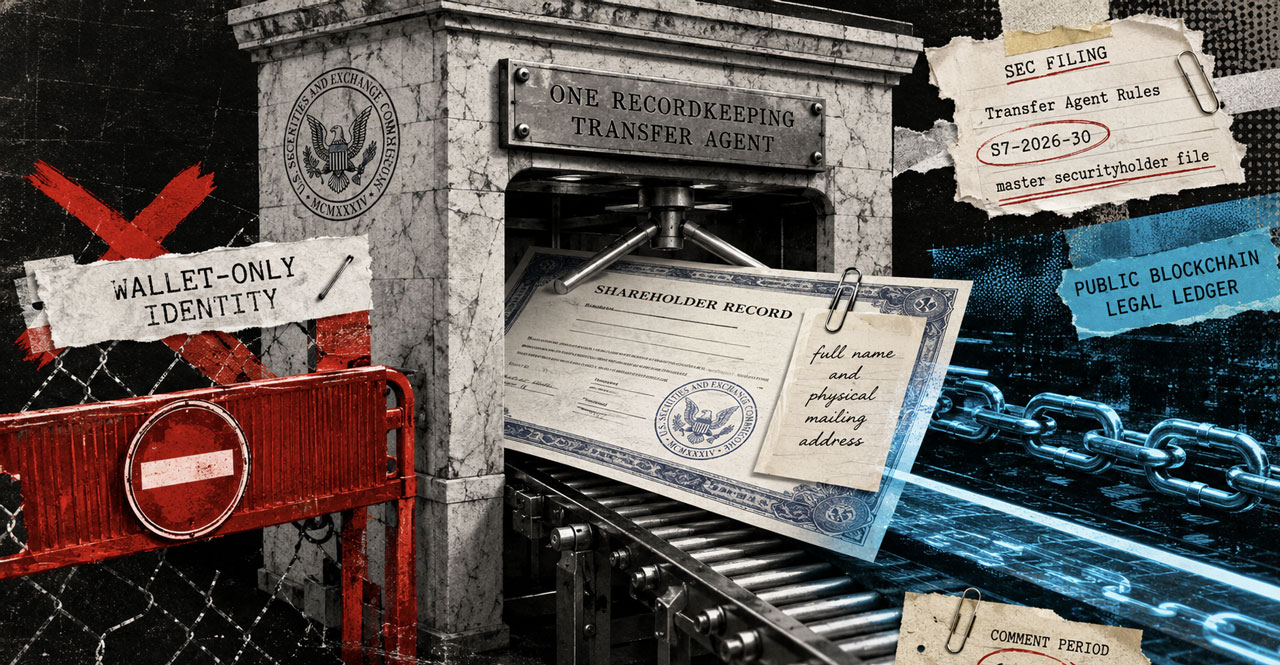
The U.S. Securities and Exchange Commission (SEC) is rewriting decades-old Wall Street rules to allow public blockchains to become the primary technology for determining who legally owns a stock. Under the proposed framework, distributed ledger technology can be utilized to track securities ownership, moving away from systems established in the 1970s. However, the rule maintains a bridge to traditional finance by requiring a single transfer agent to maintain oversight and ensuring that physical addresses remain the minimum identification requirement for shareholders.
This regulatory update addresses the aging infrastructure of the U.S. financial system, which has historically relied on centralized databases and paper-trail legacies. By acknowledging public blockchains as a valid medium for record-keeping, the SEC is effectively validating the utility of decentralized networks for high-stakes institutional use. The move ensures that while the underlying technology changes, the accountability of a regulated transfer agent remains to prevent the total decentralization of legal responsibility.
For the broader crypto and financial markets, this signals a massive step toward the tokenization of Real-World Assets (RWAs). By allowing the "record of truth" for equities to exist on-chain, the SEC is lowering the barriers for traditional firms to interact with blockchain ecosystems. This could significantly improve settlement speeds and transparency, as the public nature of these ledgers allows for real-time auditing that was previously impossible under old rules.
Investors and market participants should watch for the final implementation details, specifically how the SEC defines the security standards for the "public blockchains" allowed under this rule. The focus will now shift to which networks—such as Ethereum or specialized Layer 2s—will be adopted by major transfer agents to facilitate this transition. As these rules are finalized, they will likely serve as the blueprint for how all traditional securities are eventually migrated to the blockchain.