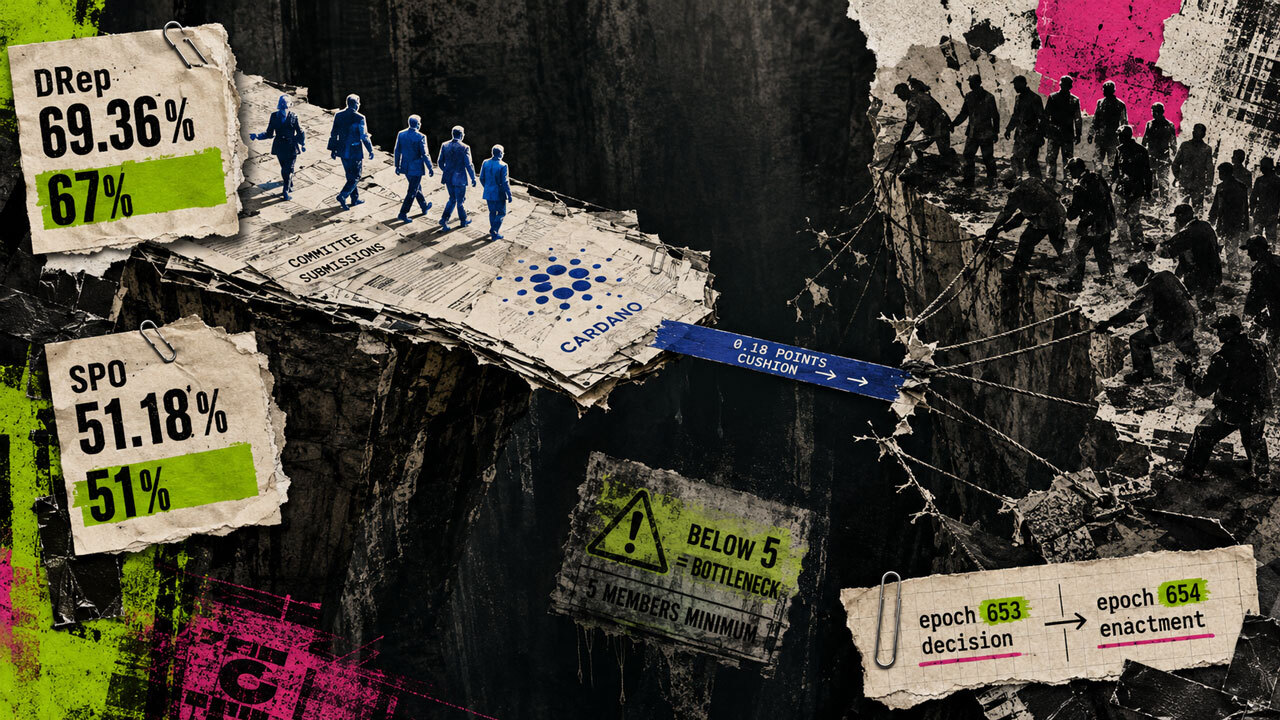
The Cardano constitutional committee renewal passed its pre-boundary vote by a narrow 0.18% margin, ensuring the continuation of a critical governance body within the ecosystem. This narrow victory was achieved despite significant challenges regarding Stake Pool Operator (SPO) participation. In Cardano’s current governance framework, the total stake of SPOs that do not cast a vote is factored into the final calculation, effectively acting as a "No" vote that weighs against the renewal threshold even without an explicit rejection.
The outcome of this vote reveals the practical hurdles of Cardano’s transition to the Voltaire era, which focuses on decentralized governance. The thinness of the margin indicates that while the community broadly supports the constitutional committee, the technical barrier to passing such measures is high due to the weight of inactive stake. Had a fraction more stake remained unallocated or non-participating, the committee might have failed to renew, potentially creating a governance vacuum as the network implements its new constitutional framework.
For ADA holders and US-based crypto investors, this event highlights the complexities of on-chain governance. The constitutional committee is vital for ensuring that technical upgrades and treasury disbursements align with the community-drafted constitution. This successful renewal provides short-term stability for Cardano’s roadmap, but the close call demonstrates that active participation from SPOs is no longer optional for those seeking to maintain the network's decentralization and operational integrity.
Moving forward, market participants should watch for new initiatives aimed at increasing SPO engagement and simplifying the voting process. As Cardano continues to roll out its decentralized governance features, the ability to mobilize stake will be a key indicator of the network's health and its ability to compete with other smart contract platforms. The next few months will be critical as the community analyzes these results to refine future voting cycles.