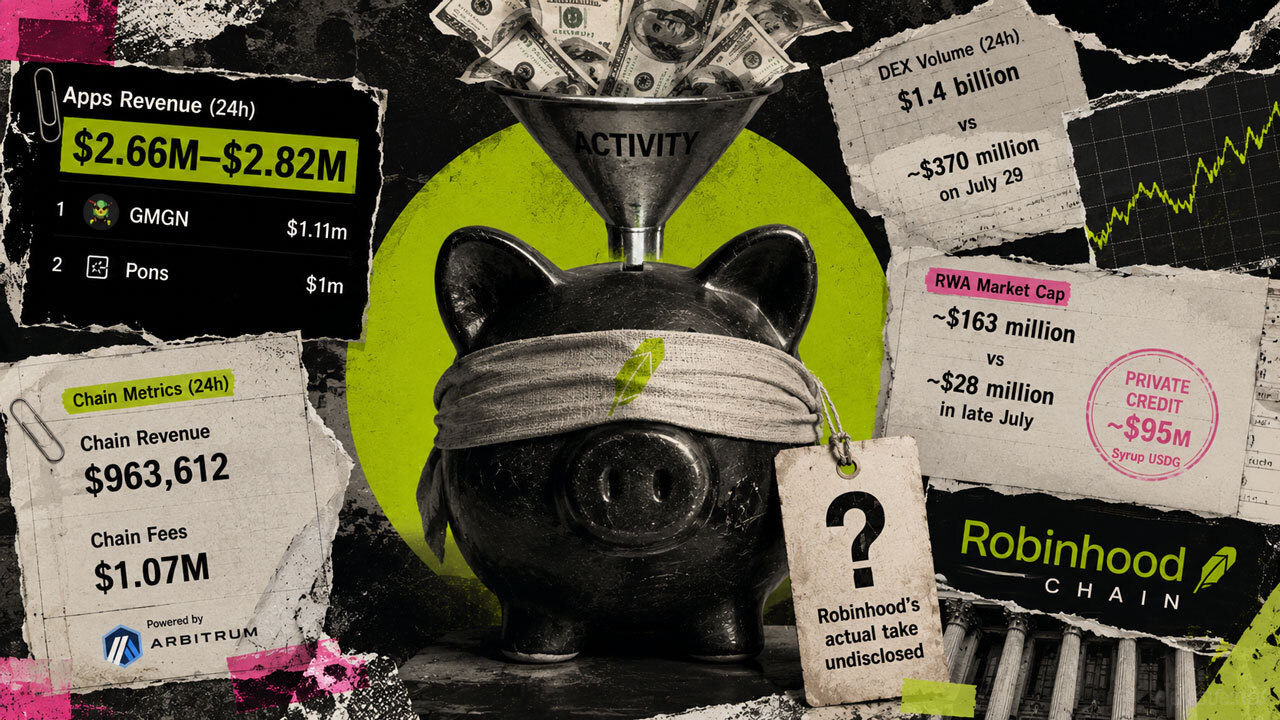
Despite a massive $2.7 million surge in revenue generated by applications on the Robinhood Chain in a single day, the platform's corporate financial health remains largely unchanged. This discrepancy exists because Robinhood's current disclosed fee-sharing structure does not provide a direct mechanism to funnel these specific on-chain transaction fees into the company’s official corporate accounts. For investors in HOOD stock, this means that while ecosystem activity is booming, it is not yet a direct driver of traditional earnings per share (EPS).
The surge highlights growing user engagement within Robinhood’s expanding decentralized ecosystem, but the 'bridge' between on-chain volume and corporate revenue is currently missing. In contrast to some competitors that take a significant cut of ecosystem fees, Robinhood’s current model focuses more on user acquisition and ecosystem growth rather than immediate monetization of decentralized application (dApp) activity. This development comes as Robinhood continues to pivot toward a more crypto-centric business model to compete with native Web3 firms.
From a regulatory and corporate perspective, this separation may be strategic. By not directly profiting from specific on-chain app activities, Robinhood may be navigating complex US SEC guidelines regarding the classification of digital assets and exchange services. However, it also creates a valuation gap where the fundamental success of the Robinhood Chain is decoupled from the company’s quarterly performance reports, potentially confusing retail investors who equate network volume with corporate profit.
Market participants should monitor whether Robinhood introduces new fee structures or 'gateway' services that finally link these ecosystem gains to the bottom line. As the company seeks to expand its footprint in the DeFi space, the ability to convert on-chain utility into shareholder value will be critical for long-term stock performance. For now, the $2.7 million milestone serves more as a proof-of-concept for the chain’s scalability than a catalyst for a stock price breakout.