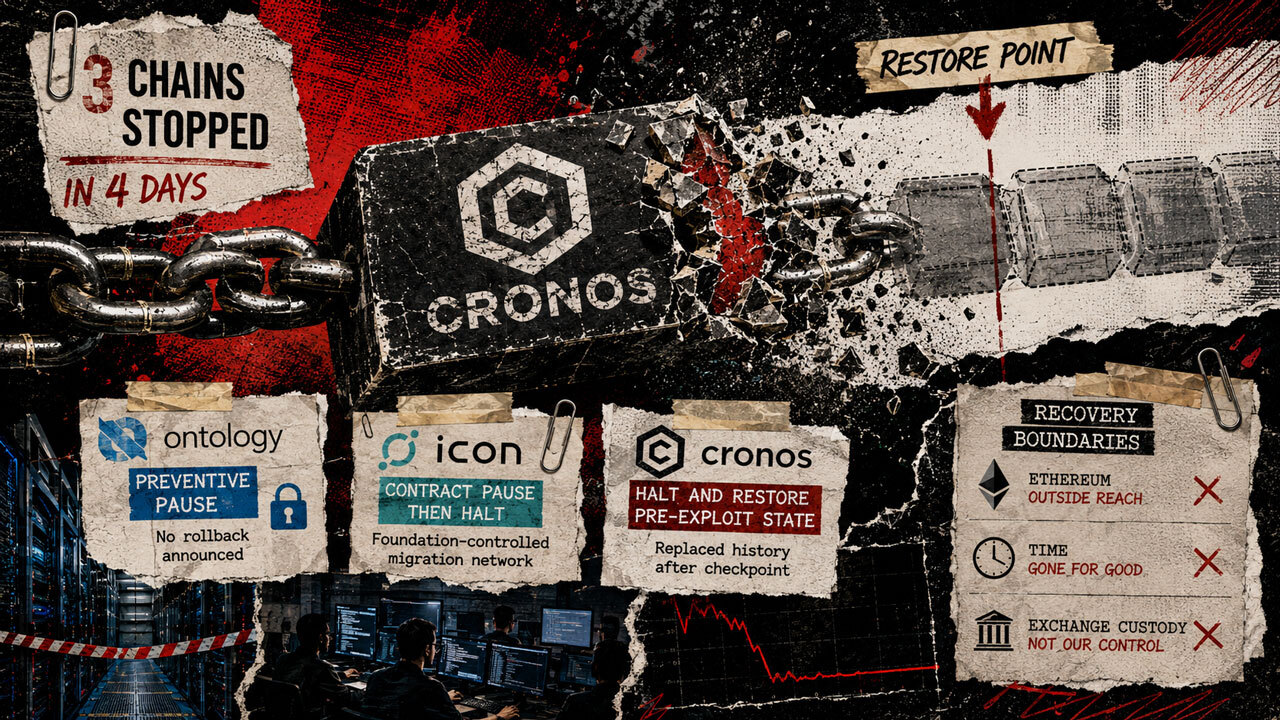
Stopping a blockchain during an exploit is a last-resort 'kill switch' that only recovers stolen funds if the assets remain within the network's internal ecosystem and validators agree on a state rollback. If a hacker manages to bridge the funds to another chain or deposit them into a centralized exchange before the halt occurs, the network's emergency powers become largely ineffective. The recent history of Cronos, Ontology, and ICON illustrates that the window for a successful recovery is often measured in minutes, not hours.
In the cases of Cronos and Ontology, the networks utilized their centralized governance structures to mitigate damage. Cronos was able to restore a pre-exploit state to nullify the theft, while Ontology successfully paused operations before a confirmed loss could be finalized. However, ICON’s experience serves as a cautionary tale: by the time the network pulled the plug, the stolen assets had already reached external exchanges, leaving the network with no way to claw back the value despite the emergency shutdown.
For US-based investors and regulators, these incidents highlight the tension between security and the core crypto tenet of immutability. The ability of a few validators or a foundation to 'stop' a chain provides a safety net but also serves as evidence for regulators, like the SEC, that many blockchains are not as decentralized as they claim. These 'emergency powers' are frequently cited in legal arguments to determine whether a token should be classified as a security under the control of a central entity.
As the DeFi ecosystem grows, users should watch how new Layer 2 solutions and cross-chain bridges implement these fail-safes. The market is increasingly scrutinizing 'security theater'—where a halt occurs but fails to protect assets. Moving forward, the effectiveness of a network’s emergency response will likely be a key metric for institutional risk assessment, as a halt that fails to recover funds offers the worst of both worlds: a loss of decentralization without the benefit of asset protection.