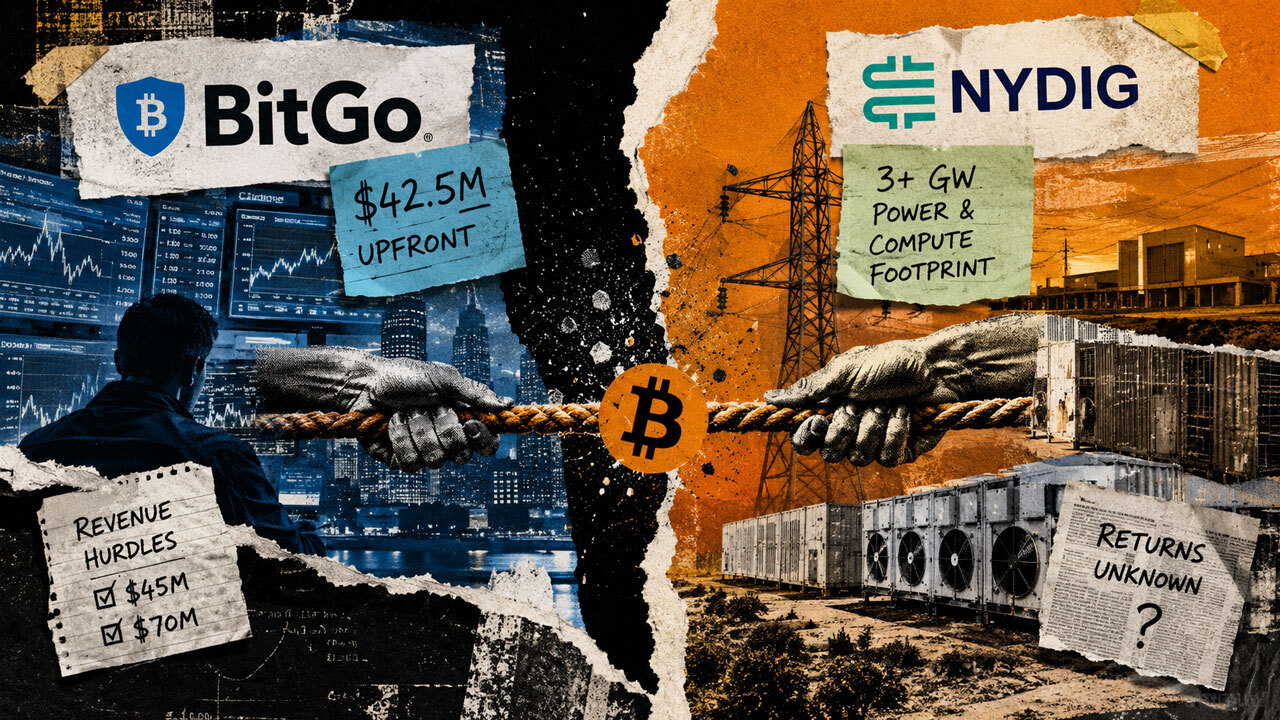
NYDIG is offloading its institutional Bitcoin trading capabilities to BitGo for an upfront payment of roughly $42.5 million as it pivots away from brokerage services to focus on its 'power-and-compute' footprint. This strategic shift involves NYDIG leveraging its claimed 3-plus gigawatt (GW) power pipeline, moving deeper into the infrastructure layer that supports both Bitcoin mining and the burgeoning artificial intelligence (AI) sector. For BitGo, the acquisition provides a ready-made institutional trading engine to complement its established custody business, strengthening its appeal to Wall Street clients.
The transaction highlights a growing trend among US-based crypto firms to re-evaluate the profitability of pure-play brokerage services in a highly competitive market. While NYDIG was once considered a preferred gateway for institutional Bitcoin access, the firm appears to be betting that the underlying energy assets required for high-performance computing (HPC) offer a more sustainable and lucrative long-term moat. This move aligns with broader market shifts where former mining companies are rebranding as data center providers to meet the global demand for AI processing power.
From a market perspective, BitGo’s expansion cements its role as a primary liquidity provider and custodian for institutional investors who require sophisticated trading tools and regulatory compliance. By absorbing NYDIG’s trading tech, BitGo positions itself to capture the trade flow of traditional finance (TradFi) players who are increasingly entering the digital asset space via ETFs and direct holdings. However, analysts note that the profitability of these trading desks remains unproven on both sides, making the $42.5 million price tag a calculated risk for BitGo.
Investors and market participants should watch how this transition affects liquidity in the institutional Bitcoin market and whether other major brokers follow NYDIG’s lead in exiting the trading space to chase energy-intensive compute opportunities. The move reflects a significant geopolitical and economic reality: in the current US market, access to gigawatts of regulated power is often more valuable than the financial software used to trade the assets produced by that power.