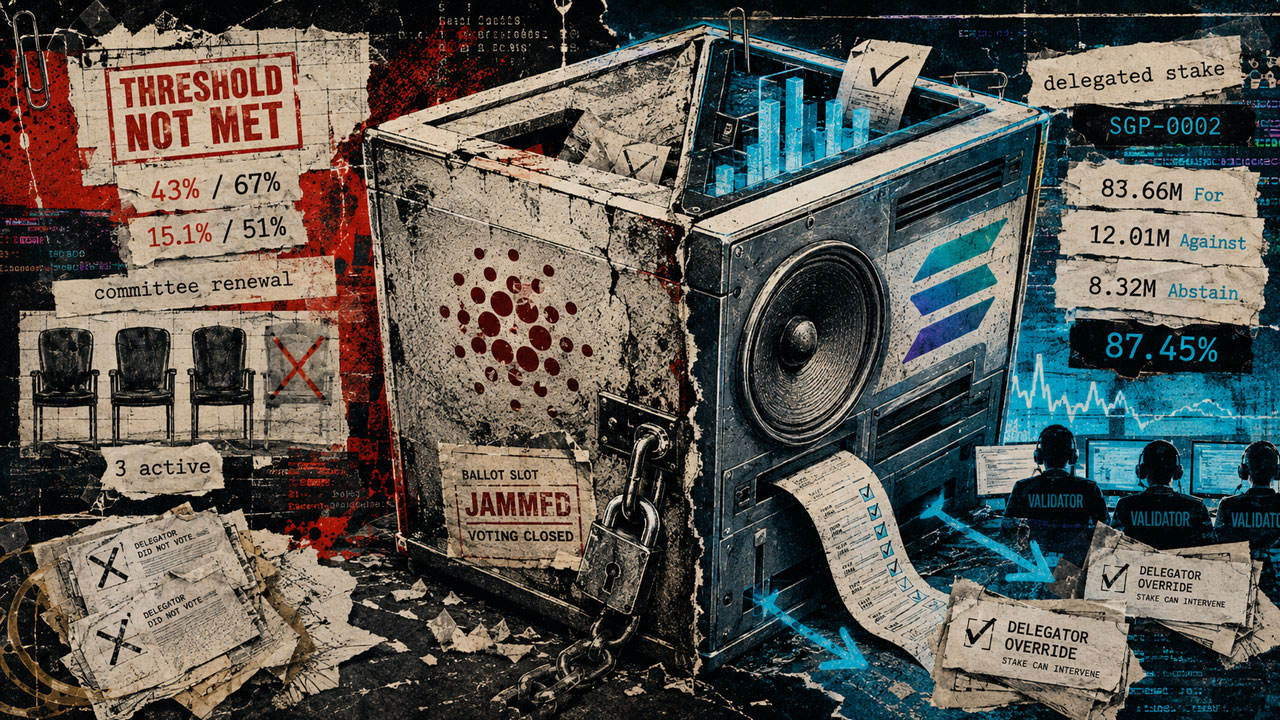
Stalling governance in Cardano and Solana is primarily driven by low voter turnout and the inability to meet required thresholds for protocol changes. In Cardano, Delegate Representatives (DReps) and Stake Pool Operators (SPOs) have recently fallen below the necessary participation levels to pass key measures. Meanwhile, Solana faces a complex environment where validator defaults, staker overrides, and conflicting pass rules create ambiguity, making it difficult to determine whether low turnout represents a lack of interest or a flaw in the system's design.
Cardano’s governance model relies on a tiered system of DReps and SPOs to ensure a wide range of stakeholders have a voice in the network’s evolution. However, recent data suggests that active participation remains below the thresholds needed to trigger major on-chain changes. This gap raises concerns about the network's ability to implement the full decentralized vision of the Voltaire era if the community remains largely passive, potentially leaving the protocol in a state of technical limbo.
Solana’s challenges stem from the technical complexity of its voting mechanisms. The system’s architecture allows for staker overrides and features conflicting pass rules, which complicates the interpretation of voting results. When validators default on votes or stakers choose not to engage, the network risks paralysis or governance capture. This complexity makes it harder for the average holder to participate, unintentionally favoring a small, highly organized minority over the broader community.
For US-based investors and observers, these governance hurdles highlight a "centralization risk" that regulators like the SEC frequently scrutinize. If a protocol cannot effectively govern itself through decentralized means due to participation gaps, it may be viewed as less decentralized than marketed. This could impact long-term sentiment for ADA and SOL, as institutional investors often prioritize networks with clear, stable, and predictable governance frameworks to mitigate operational risks.
Moving forward, readers should watch for protocol adjustments aimed at lowering participation thresholds or implementing new incentives to boost voter turnout. Both Cardano and Solana are likely to propose "governance patches" to ensure that a lack of engagement doesn't lead to technical stagnation. Monitoring the next round of governance votes for both chains will be critical for assessing their long-term resilience and their ability to scale decentralized decision-making.