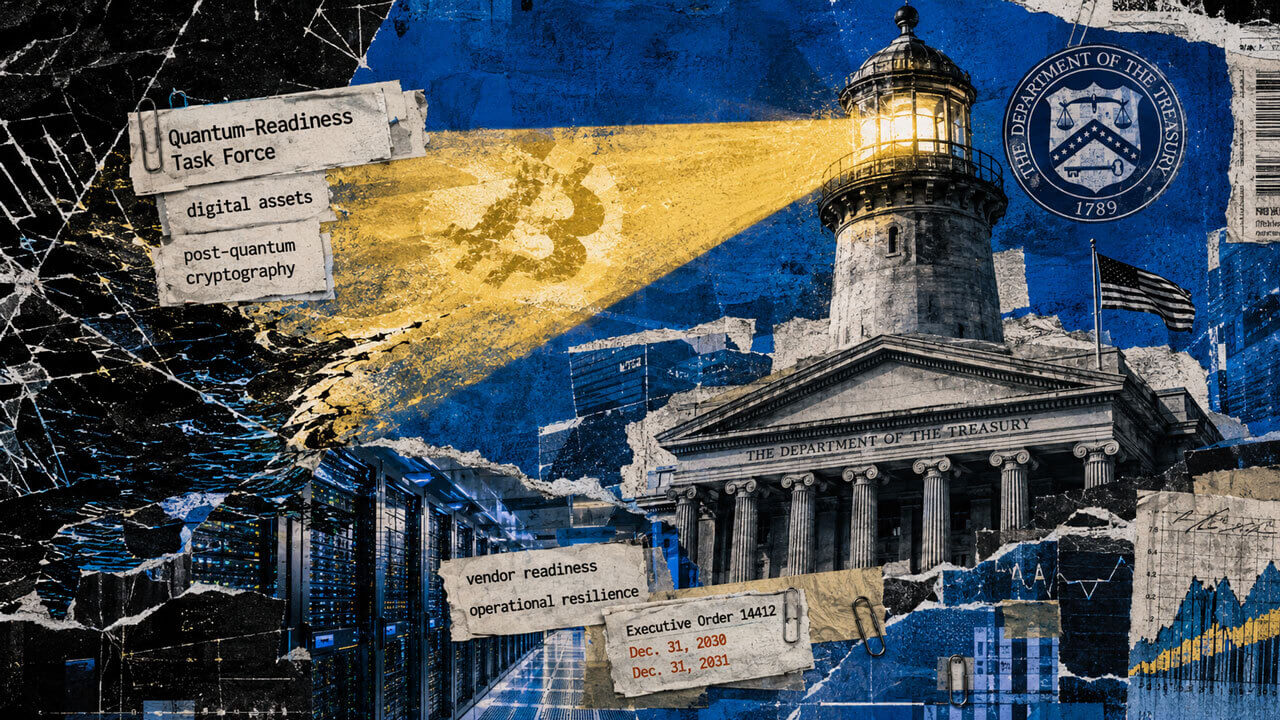
The US Treasury is moving to address the "quantum threat" to digital assets by providing crypto custodians with a new federal coordination forum to discuss post-quantum cryptography (PQC). This move signals a strategic shift toward formalizing how financial institutions protect Bitcoin holdings against future decryption capabilities. While current regulations under Executive Order (EO) 14412 primarily focus on federal agencies and their direct contractors, the inclusion of private-sector custodians in these discussions marks a significant step toward setting industry-wide security benchmarks for quantum resilience.
The primary concern driving this coordination is the estimated 7 million BTC stored in legacy address formats, such as Pay-to-Public-Key (P2PK), which are theoretically vulnerable to Shor’s algorithm if a sufficiently powerful quantum computer is developed. Unlike modern SegWit addresses, these older coins reveal their public keys directly, allowing a quantum actor to potentially derive the private key. By engaging with the Treasury, custodians aim to develop migration strategies and security protocols that prevent these dormant yet high-value assets from being compromised in the coming decades.
Despite this progress, the regulatory framework remains in its early stages. EO 14412, which focuses on the transition to quantum-resistant systems, does not yet legally bind private crypto exchanges or non-government wallet providers. However, the Treasury’s coordination forum acts as a vital bridge, ensuring that as the National Institute of Standards and Technology (NIST) finalizes its PQC algorithms, the crypto industry is prepared to implement them before quantum hardware reaches maturity. This proactive stance aims to avoid a "last-minute" migration that could destabilize market liquidity.
For the broader market, this development is a long-term neutral to bullish signal, as it demonstrates that US regulators are taking the tail risks of digital assets seriously. Investors should watch for upcoming NIST publications and potential updates to EO 14412 that might expand compliance requirements to "covered contractors" within the crypto space. As institutional adoption grows, the ability of a custodian to prove "quantum readiness" through these federal forums may soon become a competitive necessity rather than a voluntary precaution.