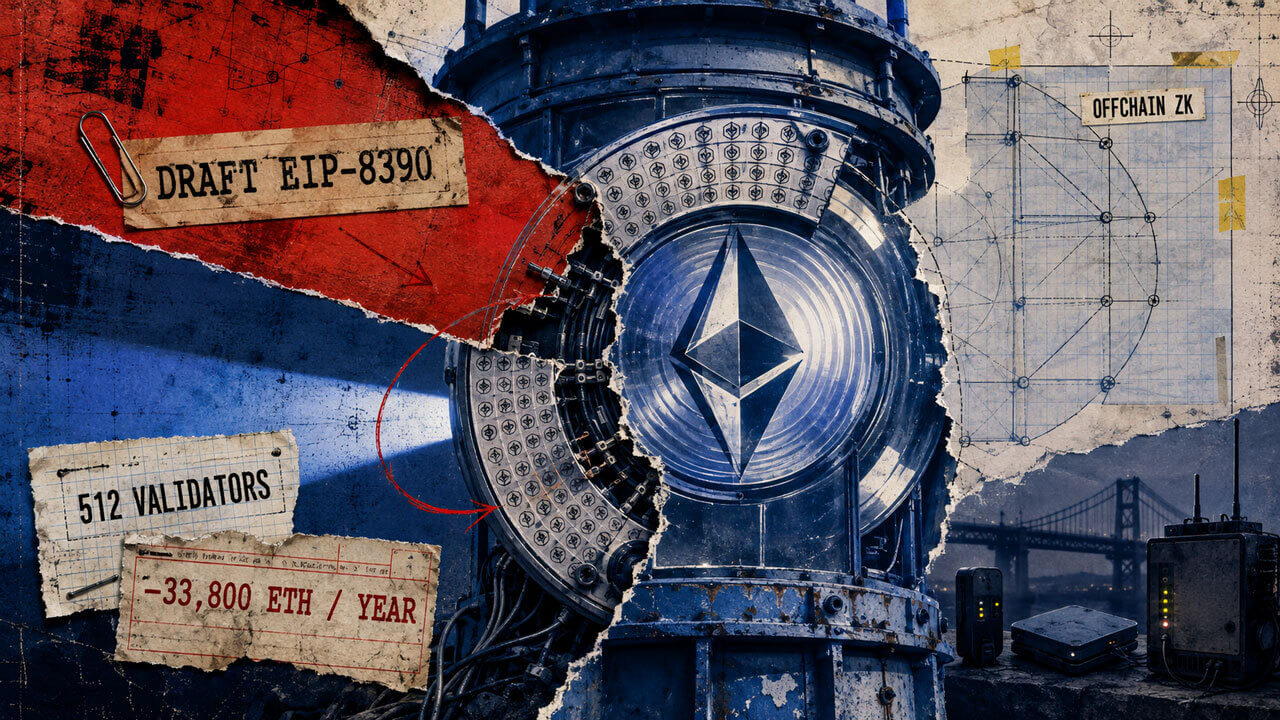
Ethereum Improvement Proposal (EIP) 8390 has surfaced as a controversial method to further refine the network's economic model by cutting annual ETH issuance by 33,800 tokens. The proposal suggests shifting to off-chain Zero-Knowledge (ZK) finality proofs to streamline the consensus process. While the reduction in new supply is generally viewed as a positive move for Ethereum’s long-term valuation, the proposal introduces a significant technical hurdle: it would render every currently deployed Altair light client non-functional, as these clients are not designed to handle the proposed change in finality data.
Technically, the proposal is currently considered incomplete by many in the developer community. It fails to define a replacement API for the infrastructure it disrupts and does not provide an incentive model for the 'provers' responsible for generating the ZK proofs. Additionally, the lack of reproducible GPU benchmarks makes it difficult for node operators to calculate the hardware requirements or the feasibility of migrating finality proofs off-chain. This lack of technical maturity suggests that EIP-8390 is in the early stages of discussion rather than nearing implementation.
From a market and regulatory perspective, the reduction of issuance aligns with Ethereum's 'ultrasound money' narrative, which is a key selling point for US-based institutional investors and spot ETH ETF providers. However, any change that impacts the stability or decentralization of the network is closely monitored. Breaking light client functionality could temporarily impact cross-chain bridges and mobile wallet providers that depend on lightweight verification methods, potentially affecting user experience across the decentralized finance (DeFi) ecosystem.
Investors and developers should watch for revisions to EIP-8390 that address the missing API and prover incentive structures. For the proposal to gain traction, the community must find a way to implement ZK finality without isolating existing light client users. Until these technical gaps are filled, the impact on Ethereum’s core protocol remains a subject of debate rather than a finalized roadmap item.