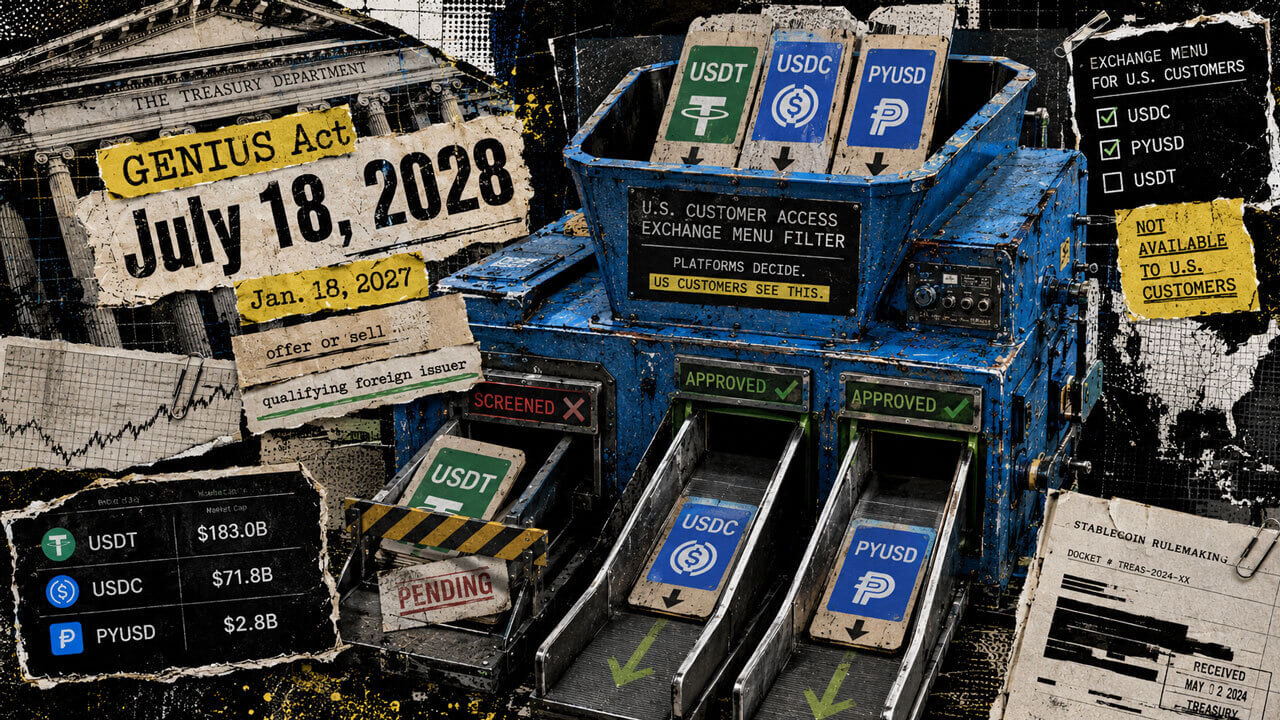
Starting July 18, 2028, U.S.-based crypto exchanges and service providers will no longer be permitted to offer or sell 'payment stablecoins' to American residents unless the assets comply with the Treasury Department’s proposed GENIUS Act rules. While these digital assets may continue to function globally on various blockchains, they will effectively disappear from the 'buy' menus of regulated domestic platforms. This deadline marks a significant shift in the federal approach to stablecoin oversight, moving from reactive enforcement to a preemptive structural ban on unregulated offshore entities.
The GENIUS Act is designed to address perceived risks to the U.S. financial system by ensuring that any stablecoin used as a medium of exchange within the country is backed by high-quality liquid assets and subject to federal examination. For U.S. investors, this means that major offshore staples, which have historically operated with less transparency than their domestic counterparts, must either obtain a federal charter or cease serving the U.S. market entirely within the next four years.
The implications for market liquidity could be profound. Many decentralized finance (DeFi) protocols and high-volume trading pairs rely heavily on offshore stablecoins like Tether (USDT). If these assets are restricted from U.S. gateways, we may see a massive capital migration toward domestic, regulated alternatives such as Circle’s USDC or PayPal’s PYUSD. This regulatory wall could segment the global crypto market into 'compliant' and 'non-compliant' zones, potentially complicating cross-border arbitrage and liquidity provisioning.
Readers should closely monitor the legislative progress of the GENIUS Act and the subsequent public comment periods, as the specific definitions of 'payment stablecoin' and 'service provider' will determine the breadth of this enforcement. For now, the 2028 deadline serves as a clear warning to offshore issuers: obtain U.S. regulatory approval or face a total lockout from the world’s largest retail crypto market.