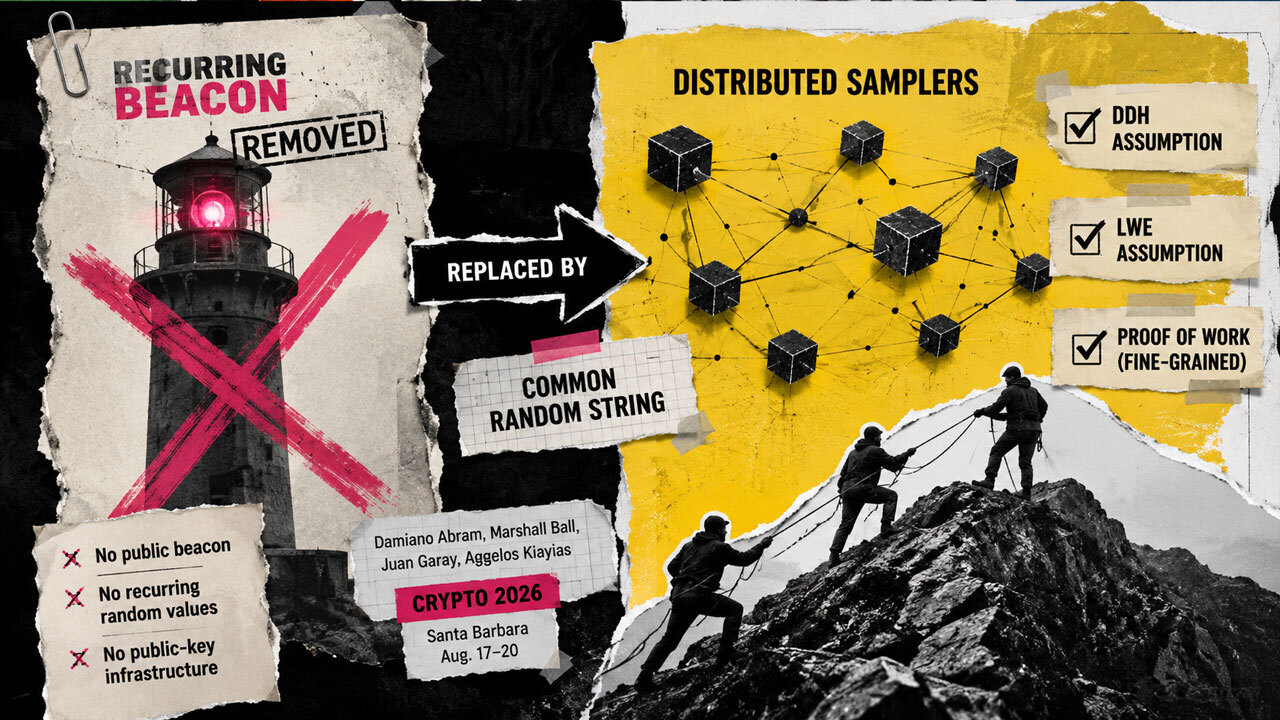
A significant architectural shift is emerging in blockchain security as researchers introduce distributed samplers to replace the industry's reliance on fresh public randomness. Traditionally, many decentralized networks have depended on external 'beacons' or periodic entropy sources to select validators and secure transactions. This new approach utilizes established cryptographic foundations, such as Decisional Diffie-Hellman (DDH) and Learning With Errors (LWE), to maintain security without an external ticking clock.
From a regulatory and geopolitical standpoint, this development strengthens the argument for blockchain's autonomy. By removing dependencies on external infrastructure—which could be subject to state-level interference or centralized failure—protocols become more robust and truly permissionless. For U.S.-based entities, this move toward self-sovereign randomness helps mitigate systemic vulnerabilities that could be exploited by sophisticated adversaries.
Market implications are largely focused on long-term network stability and the reduction of 'tail risk.' While this technical upgrade may not spark an immediate retail rally, it provides a critical layer of defense for institutional-grade infrastructure. Investors should monitor how major Layer 1 protocols integrate these samplers, as the transition could differentiate which networks are truly prepared for the next decade of adversarial conditions.
Traders should watch for upcoming protocol improvement proposals (PIPs) in major ecosystems that mention 'distributed sampling' or 'entropy hardening.' Successfully implementing these features will likely enhance the security premium of affected assets, making them more attractive for long-term holders concerned with protocol-level integrity.