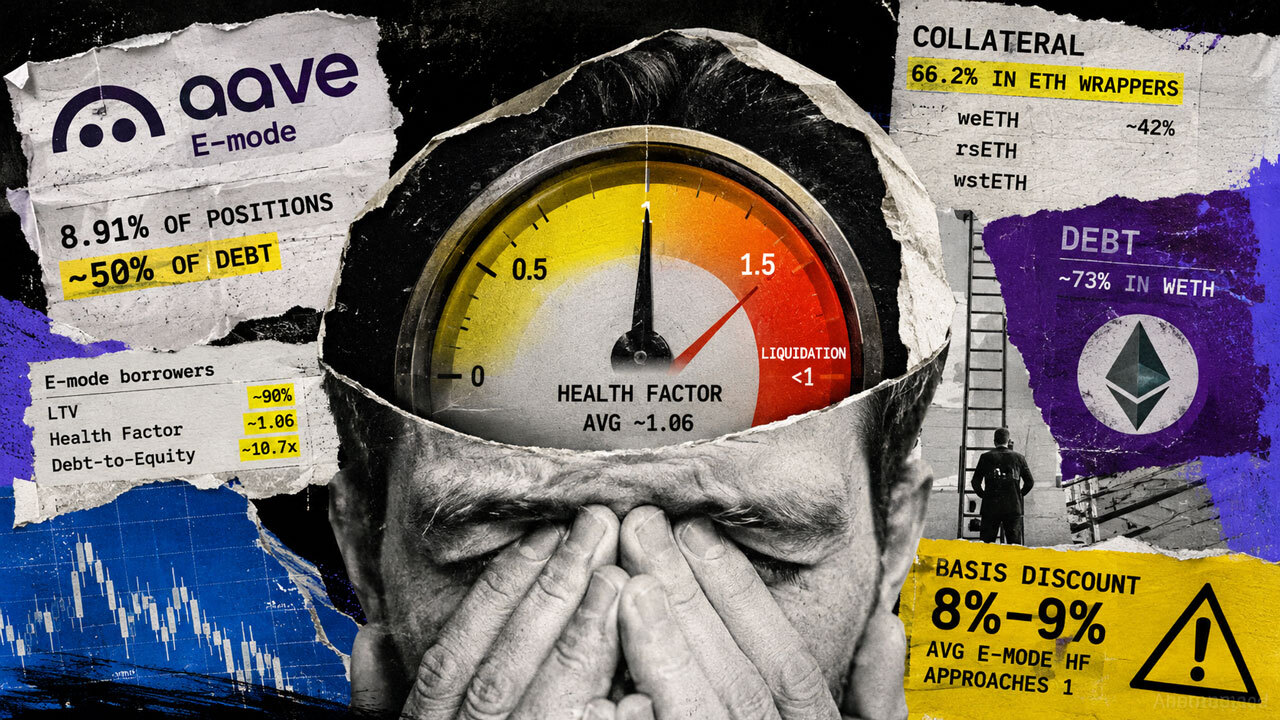
A recent research snapshot from Galaxy highlights a growing concentration risk within the Aave V3 Core protocol. Out of over 19,000 active loans, fewer than 9% of positions—leveraging Aave’s 'Efficiency Mode' (E-mode)—now account for roughly half of all outstanding debt. These positions are largely built around Ethereum correlation trades, where users loop Ether against liquid staking derivatives (LSTs) to maximize yield. While E-mode allows for higher capital efficiency, it leaves the protocol's health heavily dependent on a narrow group of high-leverage whales.
The debt-weighted loan-to-value (LTV) for these positions is hovering near 90%, leaving a razor-thin margin for error. If the price correlation between ETH and its derivatives breaks down—a scenario previously seen during market stress—it could trigger a massive wave of automated liquidations. Such an event would not only impact Aave’s liquidity but could also cause significant price volatility for ETH and its associated staking tokens as liquidators dump assets to cover the bad debt.
From a market perspective, this concentration reflects the 'recursive' nature of modern DeFi, where yield is squeezed out of increasingly complex layers of leverage. For investors and traders, this serves as a warning to monitor the peg stability of major LSTs like stETH. Regulatory bodies are also likely to view this concentration as evidence of systemic fragility in decentralized finance, potentially inviting stricter oversight of lending protocols that facilitate extreme leverage through correlated asset buckets.